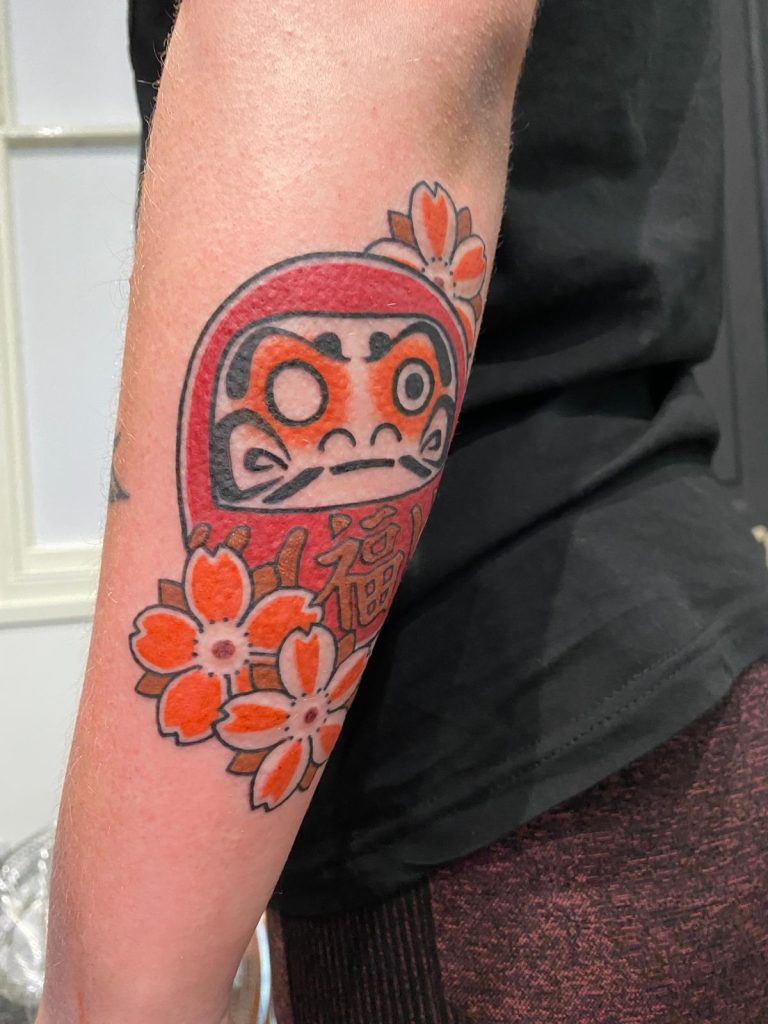
You might not know much about Japanese daruma dolls, but you’ve probably come across them in different settings, whether in real life, in movies, anime, or even on display at a Japanese restaurant. No matter how much you know about their meaning, you’re likely familiar with their distinctive face and this is one reason why the Daruma forms a popular traditional Japanese tattoo design.
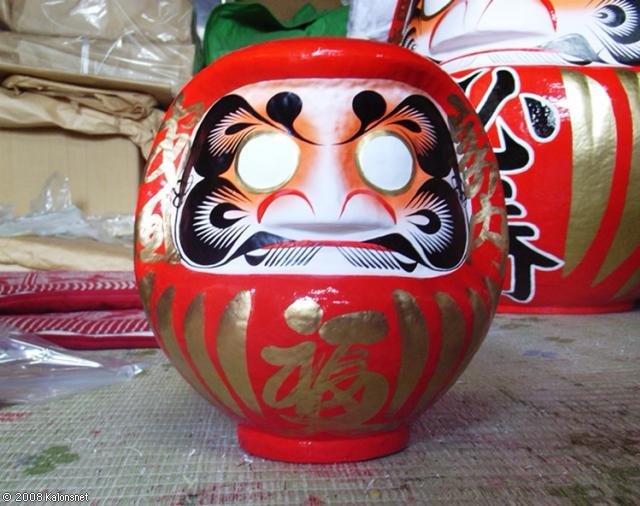
Daruma dolls are typically characterised as small, round, and red, featuring one black eye while the other remains unpainted. But what are these dolls really? What is the significance of daruma? Where did they originate, and what makes them so cherished in Japanese culture?
What Is a Daruma Doll?
Daruma dolls are popularly regarded as symbols of good fortune, often placed on shelves in homes or businesses. The tradition dictates that before displaying a daruma, the owner should make a wish or set a goal. This is marked by colouring in one eye of the doll.
While either eye can be filled in first, conventionally, it is the left eye that receives the initial mark. Once the wish is fulfilled or the goal is achieved, the other eye is coloured in, completing the daruma. But what is the origin of this custom?
The Origins of Daruma Dolls
The design of the daruma doll is based on Bodhidharma, a Chinese monk from the 5th century who is credited as the founder of Chan Buddhism in China. Although Bodhidharma was originally Chinese, he holds great significance in Japan, where Chan Buddhism evolved into Zen Buddhism. Even those unfamiliar with Buddhism recognise the profound influence of Zen in various aspects of Japanese culture.
The Unique Look of Daruma Dolls
The appearance of daruma dolls has a rather serious backstory. Zen Buddhism places a strong emphasis on meditation, and it’s said that Bodhidharma meditated for nine years, causing his limbs to wither away. This history is reflected in the daruma’s design, which features only a head and torso, without arms or legs.
On a brighter note, the colour red holds a more positive meaning. Bodhidharma is often shown wearing red robes, a colour linked to good luck, wealth, and prosperity in East Asia.
For example, during celebrations like Chinese New Year, people exchange red envelopes, or hongbao, typically filled with money. While red is the most common colour for daruma dolls, you can also find variations in blue, green, white, and gold, giving buyers the freedom to choose their favourite shade without any particular significance.
Additionally, daruma dolls often have golden kanji characters that say “fuku-iri,” which means “bringing luck.”
The Deeper Meaning Behind Daruma
While daruma dolls are often seen as good luck charms, their purpose goes beyond simply granting wishes. They act as reminders of self-discipline, perseverance, and focus. When you fill in one eye, it’s a commitment to yourself to pursue your dreams and tackle obstacles, rather than just a wish for something to come true.
The red colour of the daruma reinforces this idea of good luck, similar to another well-known Japanese talisman: the omamori charm. Unlike daruma dolls, which remain stationary, omamori are carried for luck and protection. Both types of talismans don’t grant wishes; instead, they remind the owner of their aspirations.
A popular saying related to daruma is 七転八起 (nanakorobi yaoki), which translates to “fall seven times, stand up eight.” This phrase captures the spirit of perseverance and serves as a powerful reminder to stay committed to your goals, no matter how many setbacks you face.

Cultural Influence
Daruma dolls are an integral part of Japanese culture and pop up in various forms of media, including literature, TV shows, anime, and video games.
Daruma Otoshi
This traditional Japanese toy features a stack of colourful wooden blocks topped with a daruma head. Players use a small hammer to knock away the blocks, trying to leave the head standing—a game that demands skill and precision.
Darmanitan in Pokémon
Introduced in Pokémon Black and White, this character is inspired by the daruma doll. Darmanitan enters a zen-like state when its health is low, taking on a shape that resembles a traditional daruma.
Spirited Away
In the beloved Studio Ghibli film, Yubaba has three green heads in her quarters, which echo the design of daruma dolls, though they play a different role in the story.
How Daruma Dolls are made
You might think that daruma dolls are mass-produced in factories, but they’re actually handcrafted in Takasaki, a city in Gunma Prefecture, Japan, where this tradition has been alive for over three centuries.
Back in the 17th century, local farmers made daruma dolls to seek blessings from monks passing through, hoping for good harvests. Today, the production process remains detailed and careful, using hollow structures made from a special type of papier-mâché crafted with traditional Japanese washi paper.
While modern manufacturing techniques have introduced machinery, the essence of craftsmanship is still preserved. In the past, artisans would manually apply wet paper-mâché to wooden moulds, but now they often use premade moulds dipped into liquid paper-mâché to ensure consistency and uniformity